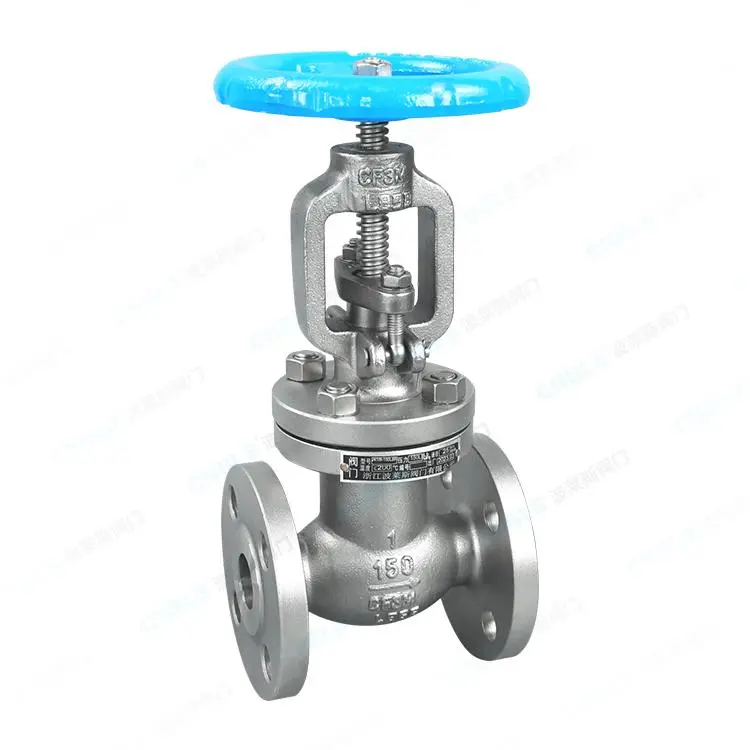
The core principle of the American standard stop valve (Class pound-level stop valve) is the same as that of the domestic stop valve, both of which **use the valve disc to lift and close or open the medium**. However, the structure is designed according to ASME B16.10 and B16.34, making it more suitable for high-temperature, high-pressure, and harsh working conditions.
I. Working Principle
1. Handwheel/actuator drives the stem up and down.
2. The lower end of the valve stem is connected to the valve disc. The valve disc is vertically pressed against the valve seat to achieve sealing. When lifted, the medium can flow through.
3. It is a type of **forced-sealing** valve. The sealing cover is tightly sealed by external force, ensuring reliable sealing. It is suitable for situations where strict isolation is required.
4. The medium flow direction is generally "low inlet and high outlet". When the fluid passes through, the flow direction changes and the resistance is greater than that of a gate valve.
5. When closed, it gets tighter and tighter; when opened, it gradually opens. The adjustment performance is excellent and it can be used for throttling.
II. Structural Characteristics (Significant Differences between American Standard and National Standard)
1. ** Pressure levels are designed in Class pounds **
The commonly used models are Class150, 300, 600, 900, 1500 and 2500. Based on the high-temperature working conditions, these models have stronger pressure-bearing capabilities at high temperatures.
2. **Structural Length Meets ANSI B16.10 Standards**
The structural length is shorter than that of the national standard globe valve or the standards are different. The flange dimensions, the center circle of the bolts, and the sealing surface forms are all completely in accordance with the American standard, and they are not compatible with the national standard flanges.
3. ** The valve body structure is thicker and heavier, with strong pressure creep resistance **
The valve body has a thick wall, and the flow channel design is more suitable for high temperature and high pressure. It is mostly used for steam, oil products, and chemical media.
4. **The sealing surface material is more wear-resistant and has higher heat resistance**
The valve disc and valve seat are generally made of **hard alloy welding**, which is resistant to high-temperature erosion and wear, and is suitable for frequent opening and closing as well as high-temperature working conditions.
5. ** More reliable stem and packing structure **
The **upper sealing structure (reverse sealing)** is mostly adopted. When the valve is fully open, the sealing surface at the top of the valve stem is in close contact, allowing the packing to be replaced under pressure.
The stuffing box is designed with a deeper structure and multiple layers of flexible graphite packing, which is resistant to high temperatures and has low leakage rate.
6. **Mainly using the exposed handle, with clear opening and closing action**
Most of them are of the "open stem type", with the valve stem rising and lowering clearly visible. The switch status can be directly determined, making them suitable for important process pipelines.
7. **The flow direction has strict requirements**
Most American standard stop valves are specified to have the "low inlet and high outlet" configuration. A flow direction arrow is cast on the valve body. Installing it in the reverse position will result in poor sealing and difficulty in opening.
8. **More applicable to various working conditions**
It can be used in high-temperature, high-pressure, steam, heat transfer oil and flammable/explosive media. It is the main cutting valve in the petrochemical, power plant and oil/gas systems.
III. Brief Summary
The American standard stop valve is essentially a **stop valve that has been strengthened in accordance with American standards**:
The principle remains the valve disc lifting seal. In terms of structure, it is thicker, stronger, and more resistant to high temperatures and pressures. The seal is more durable. It is equipped with American standard flanges and is specifically designed for harsh working conditions.